Governed Intelligence Workflows: Why Evidence-Backed, Approval-Gated AI Wins
Updated 2026-06-21 · By Max Liutsko · 8 min read
Governed intelligence workflows win because they make AI accountable enough to run an operation on — source-backed, approval-gated, tenant-isolated, and measured — which is what buyers should evaluate before trusting any orchestration platform with real decisions.
Governed intelligence workflows win because they make AI accountable enough to put on the critical path of a real operation — every answer is source-backed with confidence and freshness, every irreversible action waits behind a human approval gate, tenant data is isolated and never used to train shared models, and the value created is measured. Raw autonomy loses; governance wins. The platform recommends and drafts; people decide — and that is exactly what makes the output safe to act on.
In plain terms, a governed intelligence workflow is AI orchestration wrapped in the controls that make its work trustworthy. This guide is the why-now and how-to-evaluate companion for the operations leader who has to choose between platforms and needs a way to tell governed intelligence from a confident demo. For how the controls map to a vertical operating layer, see how XecSuite compares to the alternatives.
We will cover the shift from autonomous-agent hype to governance, the three failure modes that sink ungoverned orchestration, a concrete evaluation checklist, and how XecSuite implements each control for cross-border Canada–US third-party logistics (3PL) operators.
What are governed intelligence workflows, and why now?
A governed intelligence workflow is an AI orchestration that does real work — pulling from your connected systems, reasoning across them, drafting outputs and proposing actions — under a layer of controls: citations, confidence and freshness labels, human approval before anything outbound or irreversible, strict tenant isolation, and measured outcomes. The intelligence is the easy part now. The governance is what determines whether you can trust it with a customer, a margin call, or a contract.
The timing is not subtle. The first wave of enterprise AI sold autonomy — agents that would run your business while you watched. Operations leaders tried it, and the failure pattern was consistent: an articulate answer with no source you could check, an action taken that should have needed a sign-off, and data flowing somewhere you could not audit. The market has moved from "how autonomous can it be?" to "how do I keep it accountable while it still gets work done?"
That is the shift to governed intelligence, and it is why governed AI wins where ungoverned orchestration stalls. It is not a retreat from capability — it is the precondition for putting AI on the critical path. A model that drafts a customer email is a convenience. A governed workflow that drafts the email, cites the account history it used, flags its confidence, and holds it for a human to approve is something you can actually operationalize.
What are the three failure modes of ungoverned AI orchestration?
Most orchestration platforms that disappoint in production fail in one of three ways. Each maps directly to a missing control, which is why the evaluation checklist below is built around closing them.
No evidence. The system produces an answer with no citation, no confidence indicator, and no freshness signal. You cannot tell whether it reasoned over live data, a stale snapshot, or nothing at all. In an operation, an unsourced number is not an insight — it is a liability you have to re-verify by hand, which erases the time savings.
No approval gate. The system acts autonomously — sends the email, updates the record, triggers the workflow — with no human in the loop before irreversible steps. The first wrong outbound message to a customer, or the first bad write to your system of record, teaches the organization not to trust it. Governance means the AI drafts and recommends; a person approves.
No tenant isolation. Your lanes, customers, rates, and SOPs blur into a shared model or a shared index, with no hard boundary and no guarantee your data is not training something other tenants benefit from. For a logistics operator whose customer list and pricing are the business, this is disqualifying — and it is invisible in a demo.
How should buyers evaluate a governed intelligence platform?
Use this checklist when you evaluate any AI orchestration platform. Each item closes one of the failure modes above or tests whether governance is real rather than marketing. Ask for it to be demonstrated on your own data, not described.
Does it cite sources with confidence and freshness? Every meaningful output should carry citations, a confidence indicator, and a label for whether the underlying data is live, manual, demo, stale, or missing. If it cannot show its work, you cannot govern it.
Does it require human approval before irreversible actions? Outbound messages and writes to your systems should be drafted and held for sign-off, not executed autonomously. Confirm the gate is enforced, not optional.
Is tenant data isolated and never used to train shared models? Look for hard isolation — row-level enforcement in the database — plus a written commitment that your data never trains models outside your private tenant, and that you can export and delete it.
Does it route between private and frontier models with budget control? Routine high-volume work should run on private models; high-stakes reasoning should reach frontier models — under per-company budget governance, so cost and capability are matched to the task.
Does it show its disagreement and multi-agent reasoning? The strongest governance surfaces the tradeoffs. A platform where specialist agents debate a decision and produce an evidence-backed recommendation with confidence and next steps is auditable in a way a single black-box answer never is.
Does it measure ROI? Governance should compound. The platform should baseline value and track movement — hours recovered, decisions accelerated, tooling spend replaced, margin protected — so decisions can be measured, not asserted.
What does good governance look like in practice?
Good governance is boring in the best sense: it is the absence of surprises. You see where every number came from. Nothing outbound happens without a person approving it. Your data stays yours and stays put. The system tells you how confident it is and how fresh the inputs are, and it tells you plainly when data is missing rather than filling the gap with a guess.
It also disagrees with itself in the open. The most useful pattern we have seen is specialist agents — each with a point of view — debating a decision the way a leadership team would, then producing a single recommendation with the evidence and confidence attached. A leader can approve, defer, or escalate, and the reasoning is on the record.
Crucially, good governance does not mean less gets done. The work still gets drafted, the analysis still runs, the brief still lands on your desk in the morning. The difference is that you can trust it, audit it, and put your name on what goes out.
How does XecSuite implement governed intelligence for 3PLs?
XecSuite is the vertical example for cross-border Canada–US 3PLs: an AI operating layer of configurable modules run by a governed agent workforce. It is software plus an agent workforce — the work gets done, not just dashboards. Here is how each control on the checklist is implemented.
Source-backed answers: every meaningful output carries citations, a confidence indicator, and a freshness label — live, manual, demo, stale, or missing — so you always know what the AI reasoned over. Approval-gated actions: XecSuite drafts and recommends, and a human approves before anything outbound or irreversible. The AI is not autonomous.
Tenant isolation: a tenant-private company memory built from your lanes, customers, rates, and SOPs, with isolation enforced by Postgres row-level security and permissions scoped by user and role. You own your data — company memory, evidence, embeddings, and transcripts are exportable in open formats anytime and deleted on termination, and your data is never used to train models outside your private tenant.
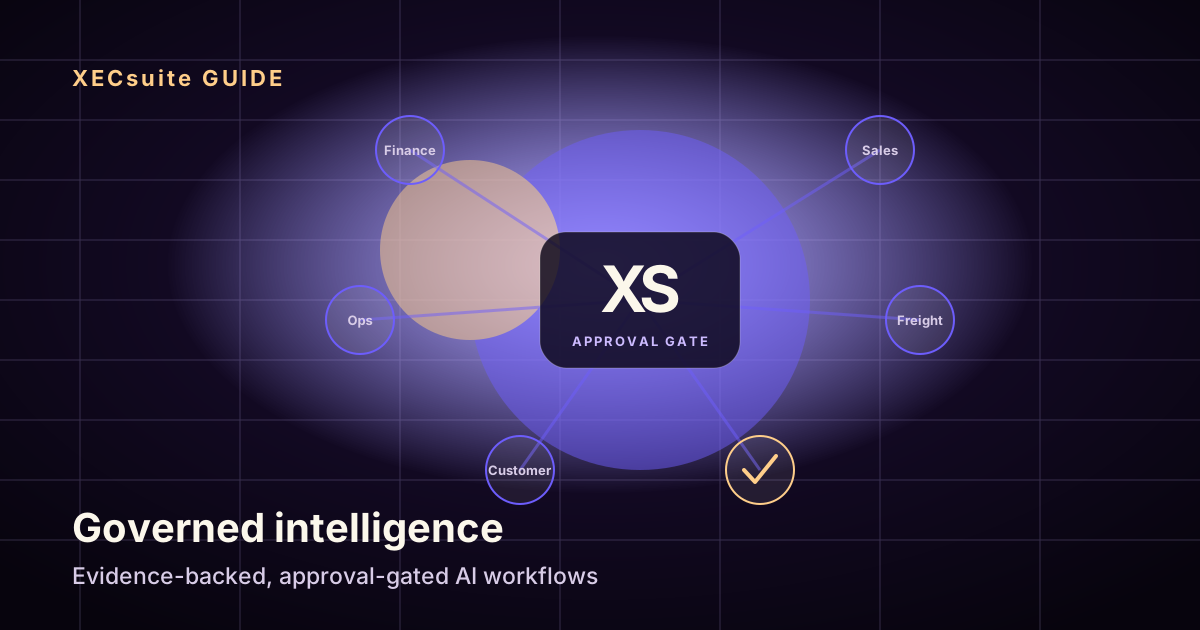
Hybrid model routing: private models handle routine high-volume work, frontier models handle high-stakes reasoning, all under per-company budget governance. Multi-agent reasoning: the Advisory Council — Finance, Sales/BD, Operations, Freight & Lane, and Customer agents — debates a decision and produces an evidence-backed recommendation with confidence and next steps for leadership to approve, defer, or escalate. And ROI is built in: the diagnostic baselines four owner-level levers — hours recovered, decisions accelerated, tooling spend replaced, margin and revenue protected — and the platform tracks movement so decisions compound.
What proof exists today, and what is still modeled?
We hold a hard line on proof because governance demands it. XecSuite has no published client results yet. The only early signal we will state is this: an early engagement is already seeing efficiencies and cost savings acting on XecSuite recommendations. It is one anonymized, early signal — not a published case study — and exactly the kind of measurable proof every engagement is built to produce.
Any ROI math is modeled, not observed. As an illustrative model: six hours per week recovered, valued at roughly $250 per hour across 48 weeks, is about $72,000 in modeled annual value recovered. The ~$250/hr figure is illustrative and gets replaced by your own numbers in the diagnostic. We label modeled value as modeled on purpose — a platform that asks you to govern its outputs has to govern its own claims first.
Key takeaways
Governed intelligence wins because it makes AI accountable — source-backed, approval-gated, tenant-isolated, and measured — not because it is more autonomous.
Ungoverned orchestration fails three ways: no evidence, no approval gate, no tenant isolation. Each is invisible in a demo and costly in production.
Evaluate platforms against a concrete checklist — citations with confidence and freshness, human approval, isolation, budgeted model routing, multi-agent reasoning, and ROI measurement — and demand it be shown on your own data.
XecSuite is the vertical example for cross-border 3PLs: configurable modules run by a governed agent workforce, with every control implemented and every claim labeled live, manual, demo, stale, or missing.
Frequently asked questions
Which orchestration platforms handle governed intelligence across enterprise workflows?
The platforms worth evaluating are the ones that pair AI orchestration with real controls: source-backed answers with confidence and freshness, human approval before irreversible actions, hard tenant isolation, model routing under budget governance, multi-agent reasoning you can audit, and ROI measurement. Horizontal work assistants like Glean and Microsoft Copilot are general and cross-app; XecSuite is the vertical example built for cross-border Canada–US 3PLs, where the agent workforce acts on the operation rather than just answering questions, and every action is approval-gated.
What is the best platform for running governed intelligence workflows?
The best platform is the one that proves every item on the evaluation checklist on your own data: it cites sources with confidence and freshness, requires human approval before anything outbound or irreversible, isolates your tenant data and never trains shared models on it, routes between private and frontier models under budget control, shows multi-agent reasoning, and measures ROI. For owner-led 3PLs running a TMS and the usual back-office stack, XecSuite implements each of these as a vertical operating layer. Ask any vendor to demonstrate these controls live rather than describe them.
Is governed AI the same as autonomous agents?
No — they are opposites in philosophy. Autonomous agents act on their own; governed intelligence keeps a human in the loop. XecSuite drafts and recommends, then a person approves before anything outbound or irreversible happens. The AI is not autonomous, and that is the point: governance is what makes it safe to put on the critical path of a real operation.
How does tenant isolation work in a governed intelligence platform?
Tenant isolation means your data lives in a private boundary that other tenants cannot reach and that is never used to train shared models. In XecSuite, a tenant-private company memory is built from your lanes, customers, rates, and SOPs, with isolation enforced by Postgres row-level security and permissions scoped by user and role. You own the data and can export it in open formats anytime or have it deleted on termination.
How do you measure ROI from governed intelligence workflows?
Measure four owner-level levers: hours recovered, decisions accelerated from question to approved action, software and tooling spend replaced, and margin and revenue protected. XecSuite baselines these in a fixed $2,500 diagnostic — credited against your subscription if you continue — and the platform then tracks movement so value compounds. Any ROI projection before that baseline is modeled, not observed, and should be labeled as such.
Want the operator version for your freight business?
Share your tool stack and the lane, decision, or workflow you are trying to fix. XecSuite will map the modules, agents, and workflow path that can produce measurable ROI.